
Product Introduction
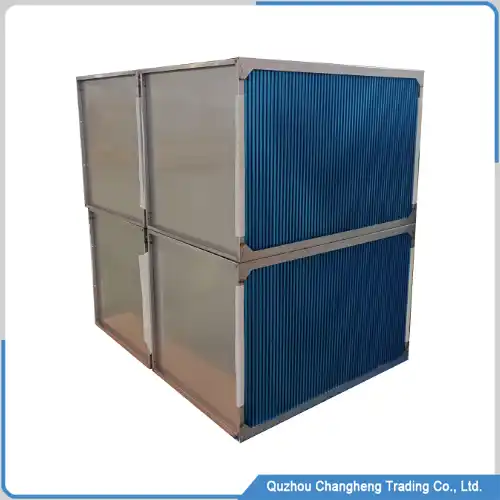
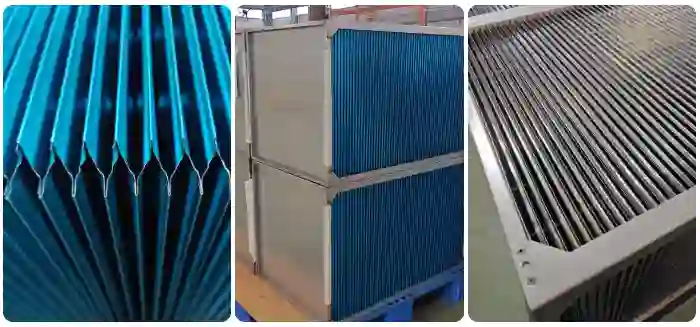
A cross flow heat exchanger is an air exchange device that is forming by pressing aluminum foil and then scientifically stacking it to form a cube. Cold air and heat control pass through this cube respectively, and then exchange heat.
The aluminum foil material thickness of this heat exchanger is usually 0.1-0.15mm. It is scientifically stacking, and the channel height of each layer is about 5-10mm. This heat exchanger has many intersecting channels, with the first layer being the hot air channel and the second layer being the cold air channel. The advantage of this design is to fully utilize the characteristics of aluminum foil, and the heat transfer efficiency can reach 40-65%.
There is a wind power plant that needs to be installed in the sea or by the seaside. There may be some salt in the air that corrodes aluminum materials, which puts high demands on the service life of heat exchangers. Therefore, some heat exchangers are of stainless steel 304 material with a thickness of usually 0.05-0.08mm.
Quick details
- Material: Hydrophilic aluminum foil
- Top plate process: sheet metal bending forming
- Raised pattern: circular
- Aluminum foil size: 200-1200mm optional
- Board pitch: 3-14mm
- Bracket material: Aluminum alloy, iron, stainless steel optional
- Aluminum plate shape: square
- Core height: 200-2800mm optional
- Bracket connection method: Rivet riveting
- Sealing material: environmentally friendly glass adhesive
How to produce cross flow heat exchanger
Aluminum material heat exchanger
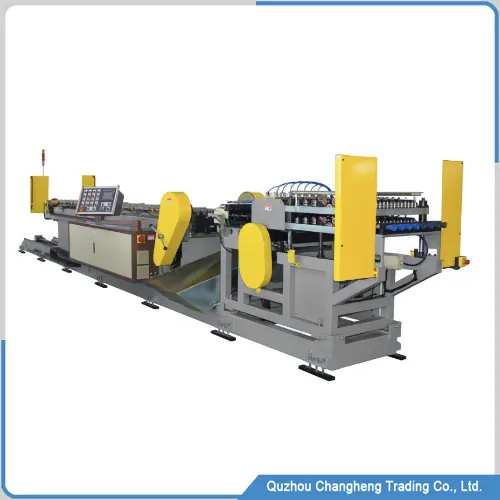
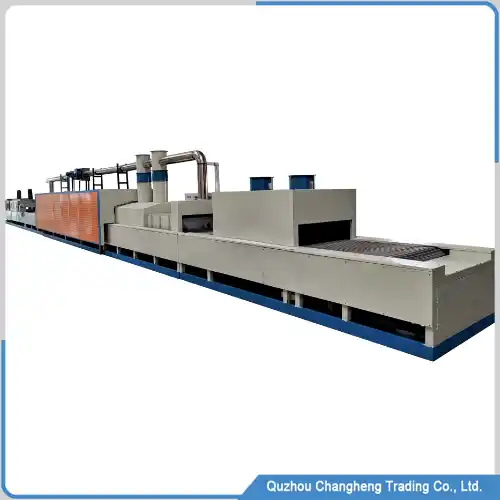
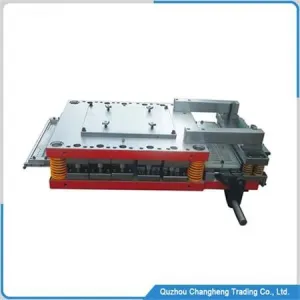
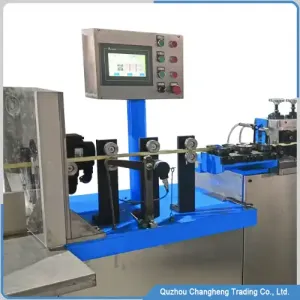
Due to the excellent ductility of aluminum material, the pressing molding of aluminum foil adopts a fully automatic production mode. The aluminum foil is automatically uncoiled on the feeder, and the pressing machine continuously presses it. The moving device moves according to the length required by the user, and then cuts the required length.
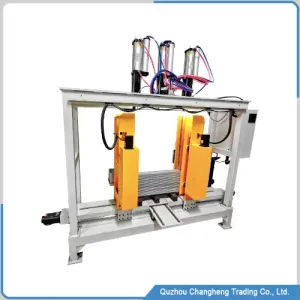
The stacking of aluminum foil needs to be manually complete by workers. Firstly, the four edges of the completed aluminum foil need to be pressed. Then, the worker stacks the two aluminum foils together and uses specialized tools to bend and lock them. Usually, the edges of each aluminum foil are bent twice, and this structure will not leak.
The materials for the top and bottom plates are usually galvanized iron plates, which are formed into the required shape by sheet metal bending machines. Installation also requires manual operation. Firstly, glass glue needs to be added to the inner side of the column, and then the column and top plate are riveted with rivets.
Stainless steel material heat exchanger
The production type of stainless steel cross flow heat exchanger is basically the same as that of aluminum heat exchanger, but the edges of the two stainless steel materials are welding. Because stainless steel material has very high elasticity, it is very easy to rebound after bending, so it must be welding to ensure that it has a long service life.
Working principle of cross flow heat exchanger
This type of heat exchanger discharges indoor exhaust gas to the outside, and fresh air from the outside enters this heat exchanger and then enters the indoor area. Imagine in northern cities where winter may be minus 40 ℃, fresh air entering the indoor area directly can cause a rapid drop in indoor temperature. Therefore, the waste heat discharged from the exhaust gas to the outside warms the fresh air entering the indoor area, which helps to save resources.
Heat exchangers usually have two independent channels, with hot and cold air passing through their respective channels and utilizing the thermal conductivity of aluminum foil to convert heat. The two air streams do not mix and the air entering the room is absolutely fresh. High end air conversion equipment installs meltblown fabric at the air inlet to isolate PM2.5 dust in the air.
Advantages of cross flow heat exchanger
- Compact design
The most popular design now is square, with very even gaps between stacked aluminum plates and two intersecting channel designs. It not only has a compact appearance, but also has a very high heat transfer efficiency.
- There are two folds on the edge
The edge of the aluminum foil is manufacture using a double bending process, so there is no risk of leakage even with slight bumps.
- Lower cost
Because the raw material used is 0.1mm aluminum foil, its weight is relatively light, so compared to other types of cross flow heat exchanger, its cost is very low.
- High heat transfer efficiency
Aluminum foil has small waves, which not only increase its strength, but also generate strong wind pressure when air passes through the channel and comes into full contact with these small waves, achieving high heat transfer efficiency.
What sizes of cross flow heat exchanger do we offer
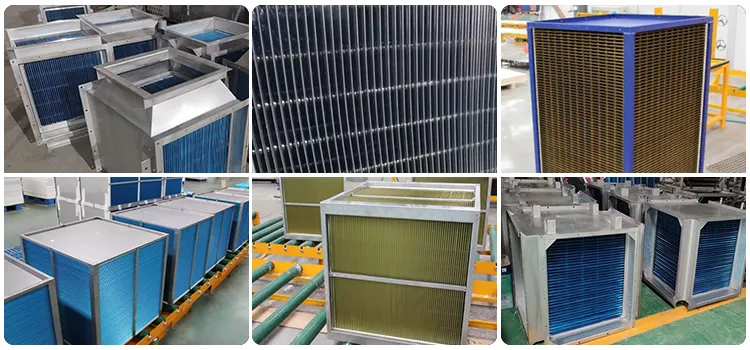
So far, the heat exchangers we can provide are square. The minimum size of the aluminum plate is 200 * 200mm, and the maximum size is 1200 * 1200mm. If you need a larger size, we can combine multiple cores together to meet your requirements.
For example, if the size you need is 1600 * 1600mm, we can use four 800 * 800mm cores and combine them together with rivets to make their size meet your requirements.
Our entire cross flow heat exchanger size is as follows:
| Aluminium plate size | Aluminium plate size |
| 200*200mm | 800*800mm |
| 300*300mm | 850*850mm |
| 400*400mm | 900*900mm |
| 500*500mm | 950*950mm |
| 550*550mm | 1000*1000mm |
| 600*600mm | 1050*1050mm |
| 650*650mm | 1100*1100mm |
| 700*700mm | 1150*1150mm |
| 750*750mm | 1200*1200mm |
Q & A
A: For regular sizes, our fastest delivery time is 25-35 days. However, for special sizes, the delivery time may be even longer.
A: Yes, we can provide heat exchangers made of this material.
A: The grade of this aluminum foil is 8011, with hydrophilic coatings on both sides to protect it from oxidation in harsh environments.
A: The aluminum foil of that type of heat exchanger is usually rectangular, such as 200 * 600mm. We are still developing this size of heat exchanger and will provide it in the future.


 WECHAT


