
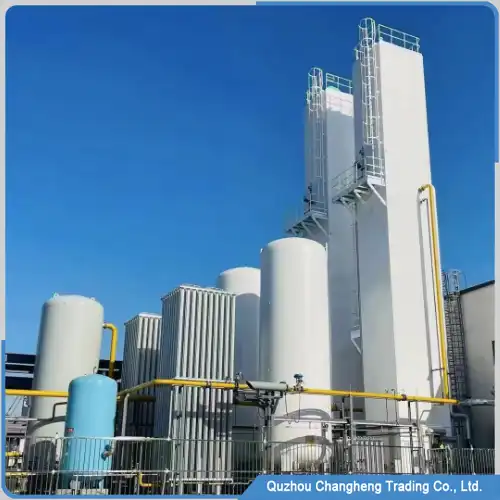
What an industrial liquid nitrogen plant does
An industrial liquid nitrogen plant is a complete system that separates air into liquid nitrogen. In the industry it is better known as a cryogenic air separation unit, or ASU. It compresses and purifies the air first, then cools it to below -190 °C until the air turns into liquid. From there it uses the difference in boiling point between oxygen and nitrogen to pull the nitrogen out.
This is not the same thing as a PSA nitrogen generator. A PSA unit delivers gaseous nitrogen, typically 10-150 Nm³/h, and production stops the moment the line stops. A liquid nitrogen plant delivers an actual liquid. You can store it in a tank, or load it into a road tanker and ship it out.
Take our KDN-250Y as an example. Its output is 250 Nm³/h, which works out to 7.5 tons of liquid nitrogen per day. Purity is 99.999%. The ex-cold box pressure is 0.2 MPa, high enough to go straight into the storage tank without any additional booster.
The larger KDN-400Y in the same series produces 12 tons per day. Something interesting happens to the air ratio: it drops from 12.0 down to 10.5. The smaller the plant, the more air you have to process for every ton of liquid nitrogen you get out.
Its continuous operation cycle is 2 years. That is the interval between two defrosts, and for any plant running around the clock this matters more than the output figure.
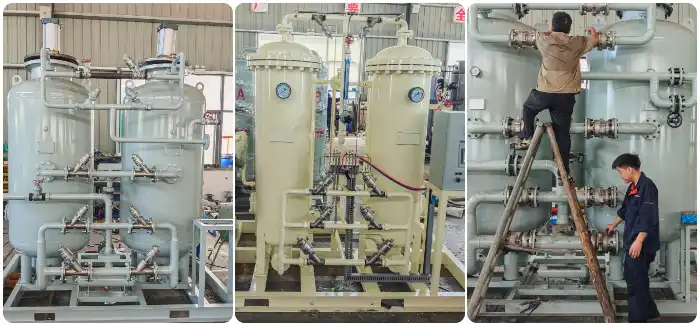
What comes with the plant: the equipment list
An industrial liquid nitrogen plant is not one machine. It is a dozen units connected into a line, and if any one of them is missing, you get no liquid at all.
- Self-cleaning air filter, model ZKG-100. It keeps dust out. It is also the only unit in the whole line whose power rating was actually filled in on the supplier list: 0.2 kW.
- Air compressor. It brings the air up to around 11 Bar.A.
- Air pre-cooling unit, UF-2600/1.0. It brings the air down to 5-10 °C.
- Air purification system, HXK-2600/1.0. It is filled with molecular sieve and removes water, CO2 and hydrocarbons. Two vessels alternate between adsorbing and regenerating, and regeneration runs at about 170 °C.
- Rectification column, FN-240Y. It sits inside the cold box and is the heart of the plant. It also has the longest manufacturing lead time.
- Booster turbine expander. It supplies the refrigeration for the whole system.
- Cryogenic refrigerator, UFD-2400/14.5.
- Instrument control system, built around a Siemens S7-1200 PLC.
- Electrical control system: medium-voltage switchgear KYN28A-12 with low-voltage GCS, matching the 6 kV and 380 V supplies.
- Cryogenic storage tanks, 15 m³ at 0.8 MPa, two units.
Industrial Liquid Nitrogen manufacture factory video
Cryogenic air separation: how air becomes liquid nitrogen
Compression and purification
Air passes through the self-cleaning filter first, then into the compressor, which takes it to around 11 Bar.A. Compressed air leaves the compressor hot, so the pre-cooling unit brings it down to 5-10 °C. A refrigerated dryer condenses the water into ice and drains it off.
Next comes purification. The air enters the molecular sieve vessels. Water, CO2 and hydrocarbons all freeze solid below -190 °C, so they have to be removed here. If they are not, they will block the heat exchange channels inside the cold box. Normally one vessel adsorbs while the other is heated for regeneration, and the changeover cycle is about 4 hours.
Cooling down
The purified air enters the cold box. Part of it goes to the booster turbine expander, because expanding gas absorbs heat, and that is where the plant gets its refrigeration. The rest of the air flows through the main heat exchanger against the returning cold gas, drops below -170 °C and gradually liquefies.
Rectification
Liquid air enters the rectification column. Nitrogen boils at -196 °C and oxygen at -183 °C, a gap of 13 degrees. On the trays, the vapour and liquid phases contact each other again and again. Nitrogen rises, oxygen sinks. High-purity nitrogen collects at the top of the column and, once condensed, becomes liquid nitrogen.
It leaves the column at 0.2 MPa and goes straight to the storage tanks. If the bottom of the column is configured for it, you can draw liquid oxygen at the same time. That is one reason large projects go cryogenic: one air stream, several products.
Advantages of Industrial Liquid Nitrogen
- High purity. 99.999% is standard, and the liquid is essentially free of impurities. That is exactly what photovoltaics, semiconductors and medical users are paying for.
- Large output. From 7.5 tons a day upward. A 20 m³ road tanker is full in half a day.
- Long running cycle. Two years of continuous operation before the next defrost, and the rectification column and main heat exchanger last 20 to 30 years.
- It can be stored and transported. A PSA nitrogen generator cannot do this. Liquid can be stockpiled, and it can also be sold.
- Centralised control. A Siemens S7-1200 manages every unit, so an operator can see the whole line from the control room.
Where it is used
The most common application is protective atmosphere for aluminum brazing. The tunnel of an aluminum brazing furnace needs a continuous nitrogen flow to stop the aluminum from oxidising. A stable nitrogen supply means stable braze quality, and when we put together a brazing furnace proposal we usually include this plant in the same package.
Then there is food freezing, where liquid nitrogen spray beats mechanical freezing by a wide margin. Electronics and semiconductor manufacturing use it for cooling and as a shielding gas. Medical and biological samples are stored in it. The chemical industry uses it for inerting and purging, and it also shows up in metal heat treatment.
One thing should be clear, though. This plant is not for everyone. If you only use gas on your own site, consume less than a few tons a day, and what you need is gaseous nitrogen, a PSA nitrogen generator is enough. Purity of 99.5%-99.999% is well within its range, the investment is far lower, and it starts up in minutes. A cryogenic plant takes around 24 hours from start-up to first liquid. It is built for large scale, for liquid, and for shipping out. Used for anything else, it is a waste of money.
Q&A
250 Nm³/h is a gas volume flow. Nitrogen has a density of 1.25 kg/Nm³ at standard conditions. Multiply 250 by 1.25 and you get 312.5 kg/h. Multiply that by 24 hours and you have 7.5 tons. As a liquid volume that is about 9.28 m³ per day, using a liquid nitrogen density of 808 kg/m³.
Seven months for the KDN-250Y, FOB Shanghai. One caution: the rectification column and the booster turbine expander are both long-lead items. When you place the order, ask the supplier for a separate milestone schedule covering column fabrication, equipment arrival, installation, and commissioning up to first liquid.
We have to answer this one honestly. On the list we hold, the power rating of each unit, the unit energy consumption and the cooling water demand are all still blank. The supplier left those fields empty on their template. We are not going to give you a number we made up. It has to be calculated against your actual site conditions. Talk to our engineers and we will confirm it with the manufacturer before we come back to you.


 WECHAT


